I decided to pick up the Matched Play Guide just to add some variety to my games of The Old World. In this post I’m going to delve into the book to get my initial impressions. Let’s get cracking!
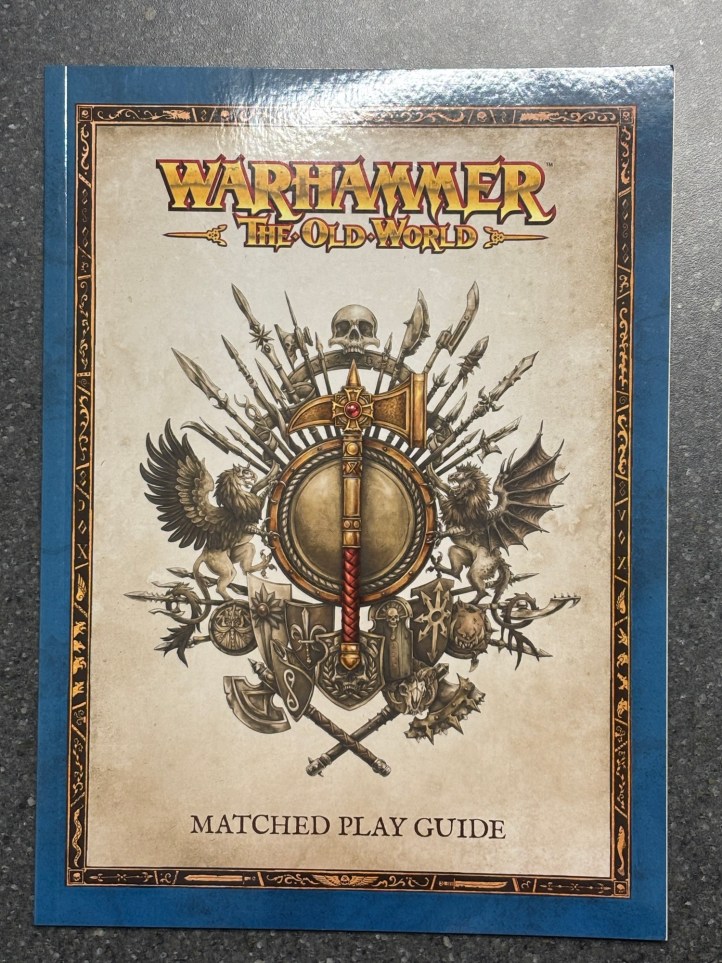
Like the Arcane Journals the Matched Play Guide is a soft cover book and is 47 pages long.
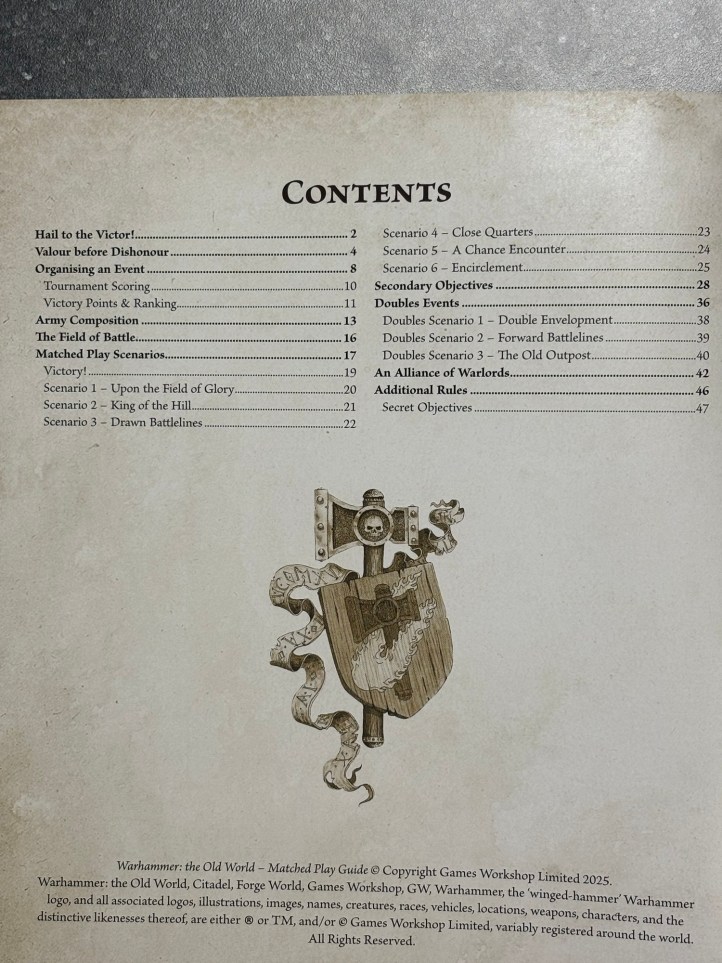
The first section of the book just talks about Warhammer and Matched Play events, i.e. tournaments. If you have this book you probably know what a tournament is, but hey every book has to start somewhere!
I really like the second section as it is a throwback to articles I remember in old school issues of White Dwarf in that it describes The Cardinal Rules of fair play and good sportsmanship. I have run many one day Warhammer tournaments in the past and for the most part they have been courteous affairs. Still, I’d suggest most gamers would have a better time if both they and their opponents read this section before their tournaments after hearing some horror stories in the past!
The section on scoring provides a victory points table which corresponds to a tournament table to determine how stunning the victory (or conversely the loss!) is for each player. This table would be nice for regular games of The Old World to determine victory, and it is very similar to ones my group has been using through the various editions, including those who played The 9th Age.
Under Army Composition the Matched Play Guide provides three options for Tournament Organizers: Open War, Grand Melee and Combined Arms. All three rules state mercenaries are always allowed. The Open War rules follow all the rules in the various army books with no additional restrictions. Grand Melee prohibits players from spending more than 25% of their points on any single character or unit and limits the amount of Wizards to any number of level 1 or 2, but only allows 1 level 3 per 1,000 points and 1 level 4 per every 2,000 points. I have a feeling this restriction is less necessary with the current FAQ limiting Wizards effect but it is still potentially game changing. Combined Arms reduces the amount of duplicate units or characters in an army. If a unit is already restricted its restriction still stands, however, unlimited units have the following cap
- 0-3 Characters
- 0-4 Core Units
- 0-3 Special Units
- 0-2 Rare and Mercenary Units
Horde armies will probably have a harder time dealing with this than more expensive troops but this should ensure greater diversity in units at a tournament.
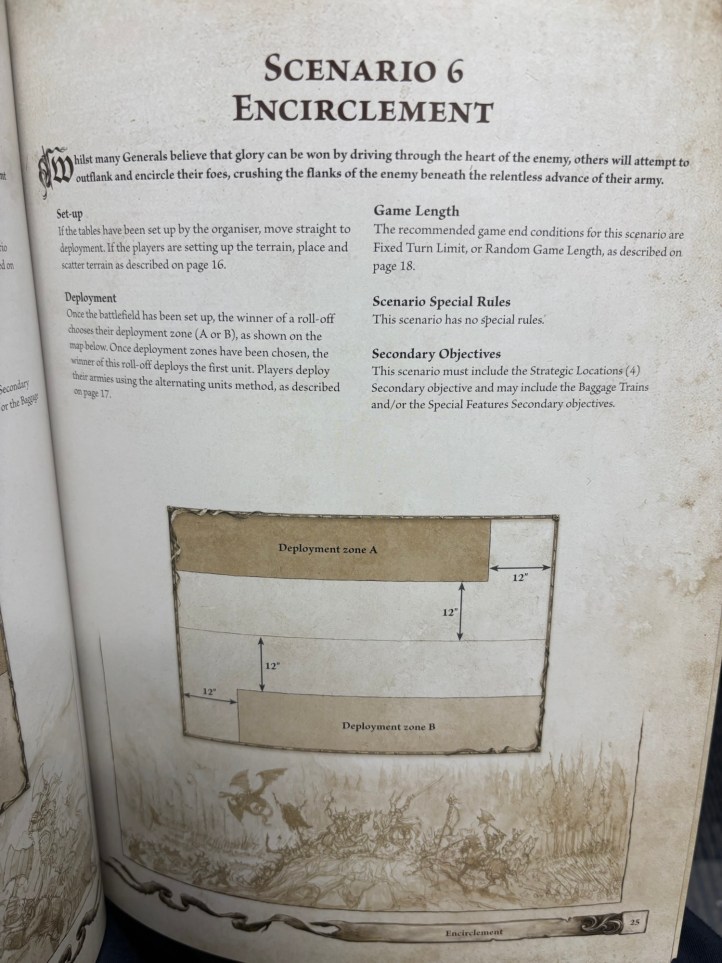
If you’ve been reading my Arcane Journal reviews you’ll know I’m a big fan of the different scenarios. This book contains six different scenarios with multiple variations available. Unlike the Arcane Journal scenarios these scenarios all call for even points and are not weighted towards a certain factions.
Each scenario contains sections for Set Up, Deployment, Game Length, Scenario Special Rules and Secondary Objectives as well as a deployment map.
There are three options for Game Length; Fixed Turn Limit (always six turns), Random Game Length, and Break Point. In break point an army in considered broken when it is reduced to 25% of its total Unit Strength. The army which breaks it’s opponent gets a pre-determined bonus in victory points.
The Matched Play guide covers Common Objectives, such as killing enemy units or having them fleeing at the end of the game, adding bonus points for killing the enemy general, capturing enemy banners, or capturing certain terrain features if the scenario calls for it. The book also adds four Secondary Objectives; Baggage Train, Special Features, Domination, and Strategic Locations. Baggage Train requires each player to create a Baggage Train and has rules for controlling their Baggage Train (100 VPs) or destroying their enemies (250 VP’s). Special Features has rules for controlling specific terrain features which will give a random benefit to the unit who controls it as well as 200 VP’s at the end of the game if you still control it. Domination gives bonus victory points for controlling table quarters (50 VP’s per quarter if you have double the enemies unit strength, or 100 VP’s if there are no enemy units in the table quarter) at the end of the game. Finally Domination provides a set up to place 2, 3, or 4 objectives. Control of each objective gains the player 30 VP’s at the end of each players turn. It is important to note each of these objectives require Core units with at least a Unit Strength of 10 to control. This rule, along with the new FAQ, will help infantry regain their value to the Warhammer world!
I have to say I love the Secondary Objectives as they give the players lots of wonderful modeling opportunities to create their baggage trains, special terrain features and so on. I’m going to have to do a post on some of the features I have created or painted over the years for my tournaments!
There is a section on how to run Doubles Events, including three unique scenarios for Doubles and rules on how to modify some of the Common Objectives. There is also a section on how to run Team Events including suggestions on scoring, ranking, and match assignments. Finally there are rules for Escalation events, and secret objectives, including secret objective cards which provides characterful objectives such as Wizards Bane in which you much dispel three of your enemies spells in the same turn, or Bounty Hunter in which you must kill (or cause to flee at the end of the game/off the board) the enemies most expensive unit.
This book really brings me a lot of joy. From the chat about Sportsmanship to the suggestions on how to run a tournament, to all the cool new modeling opportunities this book harkens back to an earlier era for me. I can’t wait to really give all the different scenarios and various objectives a try! I hope I’ve convinced you to at least look at a friends copy of this book as I think you’ll really enjoy it!
-Wachtmeister
 The Wachtmeister's Patrol
[…] just posted my review of The Old World Matched Play Guide which adds scenarios and objectives amongst other things to Warhammer The Old World. I used to run […]
LikeLike